

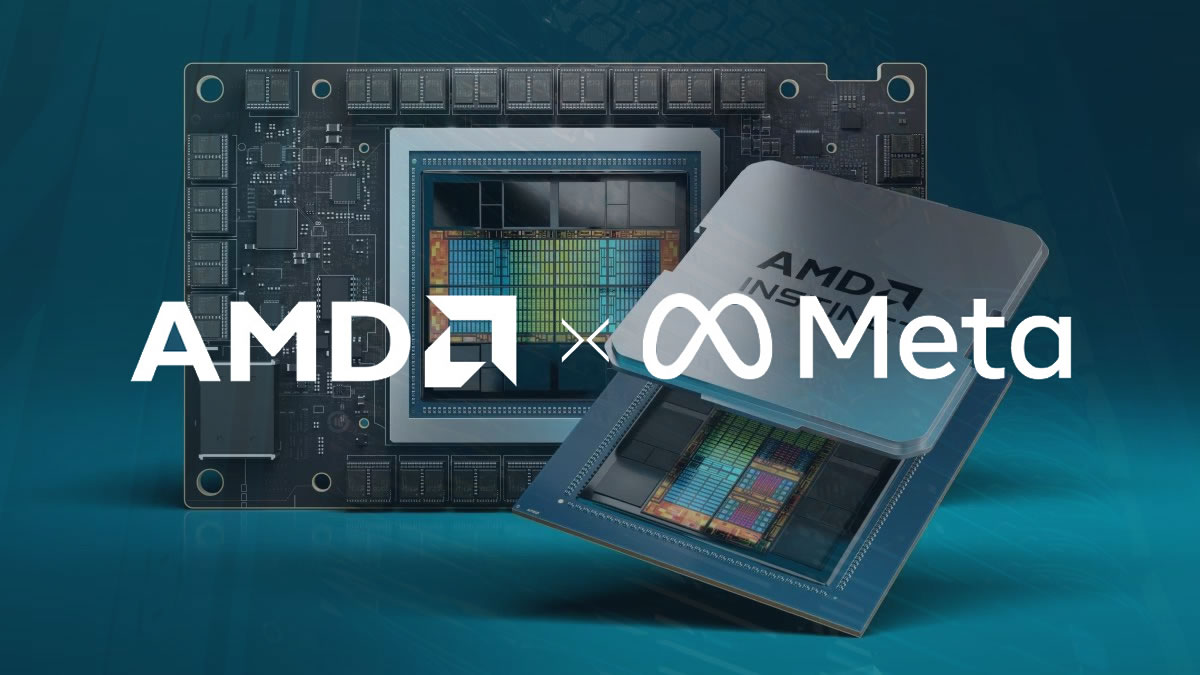
Meta has just made one of its biggest AI bets yet – and it could rewrite the balance of power in the global chip war. The company has agreed to buy millions of advanced AI GPUs from AMD, in a multibillion-dollar deal that also opens the door for Meta to become a major AMD shareholder.
For a company already spending aggressively to catch up with Google, OpenAI and Microsoft in generative AI, this is Meta saying: we’re all in.
Read Also iQOO 15R 5G Launched in India With Snapdragon 8 Gen 5, 7,600mAh
Key highlights (scan-friendly)
- Meta to purchase millions of AMD AI GPUs in a long-term deal.
- Option for Meta to become a major AMD shareholder if performance targets are hit.
- Follows Meta’s recent plan to deploy millions of Nvidia processors over the next few years.
- AMD to supply up to six gigawatts of GPU capacity to Meta, sending AMD stock up 6.5%.
- U.S. AI and cloud giants together set to spend over $650 billion in 2026 capex, nearly double 2025.
- Meta pushes AI without a cloud business, relying on better ad targeting and new AI features to justify the gamble.
Meta + AMD: a new axis in the AI chip war
American tech giant Meta has struck a long-term partnership with AMD to secure up to six gigawatts of AI-focused GPUs, the chips that power today’s most demanding generative models. The financial details remain under wraps, but AMD’s CEO Lisa Su called it a “double-digit” billions of dollars transaction, underlining the sheer scale of this move.
Mark Zuckerberg calls the tie-up a way to deploy “efficient inference compute” and ultimately deliver what he describes as “personal superintelligence” to Meta’s users. In parallel, AMD has granted Meta a convertible financial option, which could turn the social media giant into a major AMD shareholder if the chipmaker hits agreed performance benchmarks.
Read Also iPhone 18 Pro’s Selfie Upgrade Is Bigger Than You Think
Why this deal matters now
This is not an isolated bet. Meta’s AMD deal comes just days after it revealed plans to roll out millions of Nvidia processors over the next few years, signalling a deliberate multi-vendor GPU strategy to avoid overdependence on a single supplier. It also follows AMD’s similar multibillion-dollar agreement with ChatGPT maker OpenAI in October 2025, also for six gigawatts of chips, showing how fiercely AI players are scrambling for capacity.
Behind the scenes, the numbers are exploding: Microsoft, Alphabet, Amazon, Meta and Oracle together are on track to spend more than $650 billion in capital expenditure in 2026, nearly double their 2025 outlay, driven largely by cloud and AI infrastructure. AMD’s stock quickly reflected the momentum, jumping 6.5% at the opening bell on Wall Street after the announcement.
The risky side of Meta’s AI obsession
Investors see Meta’s AI sprint as riskier than that of its cloud-heavy rivals. Unlike Amazon, Microsoft and Google, Meta has no cloud platform it can directly monetise by renting out AI compute, making its massive chip buying spree harder to justify on paper.
Instead, Meta argues that its AI investments will pay off through sharper ad targeting, better content ranking and new AI features such as AI characters inside Facebook, Instagram and WhatsApp. Yet even here, the path is not fully smooth: the company recently paused access to some AI features for teenagers while it fine-tunes the products, underscoring both regulatory pressure and product risk.
Ending: a high-stakes race with no brakes
Meta is effectively stacking its future on AI silicon, betting that owning enormous GPU capacity today will translate into attention, ad dollars and entirely new user experiences tomorrow. With AMD now joining Nvidia in Meta’s arsenal, the AI chip race is no longer a one-horse show – and the platforms billions of people use every day may feel the impact sooner than we expect